A Practical Framework for Amazon Listing Optimization That Doesn't Start With Guesswork
Real Amazon listing optimization starts with facts and competitive context, not keyword tricks. A step-by-step framework covering copy, backend terms, and images.
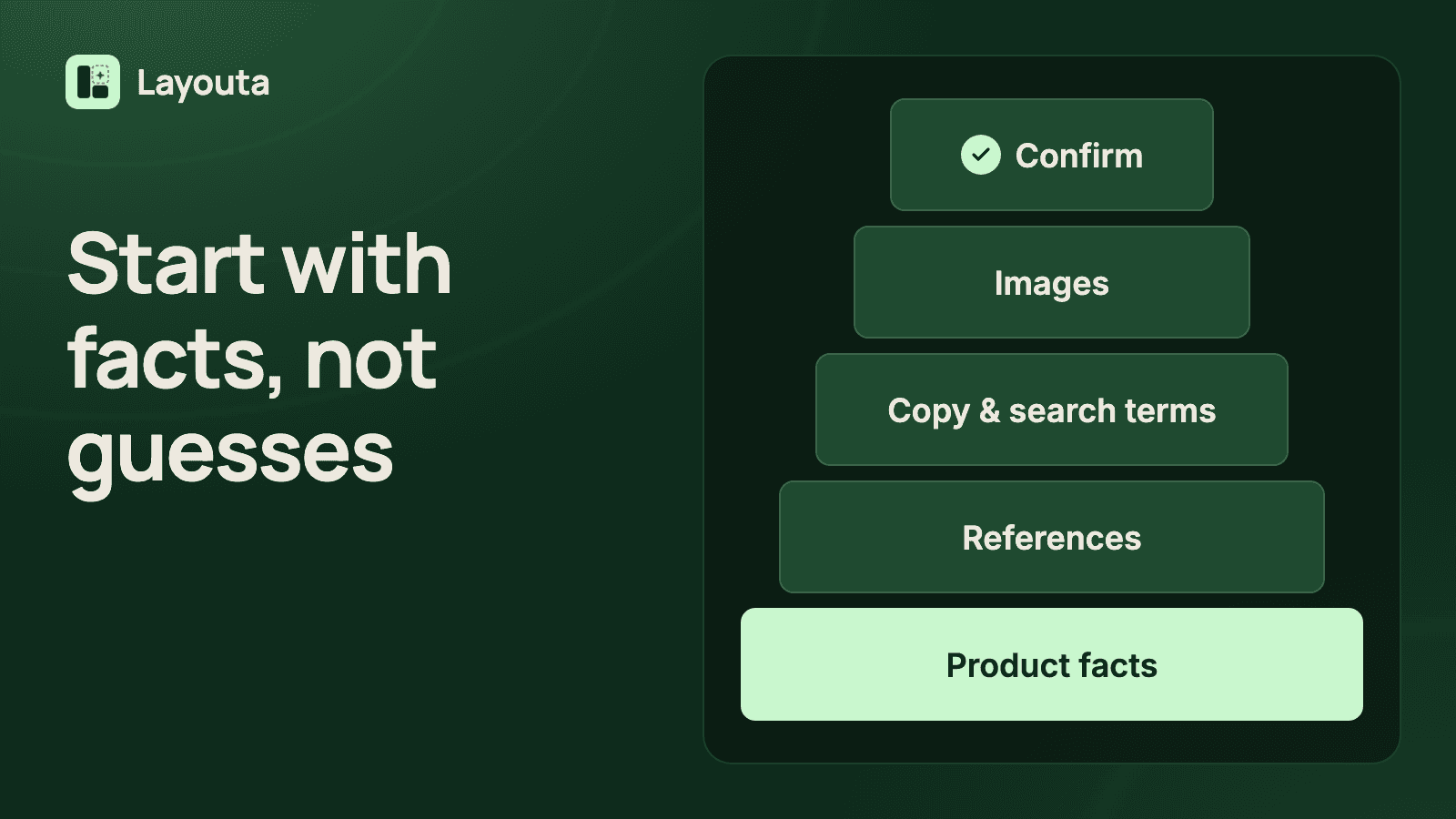
Most advice on Amazon listing optimization starts in the wrong place: keyword density targets, emoji-in-bullets tricks, character-count hacks. Those are real levers, but they're the last five percent, not the first. The first ninety-five percent of Amazon listing optimization is getting your facts, your competitive position, and your images right before you touch a single word of copy. This post walks through that order, and why skipping it is the most common reason a rewritten listing doesn't move the needle.
Amazon listing optimization starts with facts, not adjectives
A listing that says a product is "premium" and "durable" isn't optimized — it's decorated. Real Amazon listing optimization starts by writing down what's actually true about the product: exact material, exact dimensions, what's in the box, who it's built for, and just as importantly, what it should never claim. That last part matters more than sellers expect. A listing that quietly overstates a certification or a safety claim isn't just a copywriting risk; it's an account risk. Any credible approach to Amazon listing optimization treats unconfirmed claims as claims that get left out, not claims that get softened into vaguer language and kept in anyway.
This is also where a lot of self-serve rewrites go wrong. It's tempting to fill every field because a blank field feels like a missed opportunity. But a blank field that's genuinely unknown is safer than a filled field that's invented, and buyers can tell the difference between specific, checkable claims and generic filler even when they can't articulate why one listing feels more trustworthy than another.
Competitive research is part of Amazon listing optimization, but copying isn't
Looking at what's already ranking above you is a legitimate part of Amazon listing optimization — arguably the part that separates a listing written in a vacuum from one written with real market context. The mistake is what sellers do with that research: lifting phrasing directly, or worse, copying claims about materials or performance without knowing whether your own product actually backs them up.
The more useful approach is to treat a competing listing as a signal about what buyers in this category already care about, tagged by how closely it actually relates to your product. A listing for the exact same item in a different color tells you something reliable about your own product's likely strengths. A listing for a loosely similar product in the same category tells you something about the category's expectations, but nothing specific about your item. Good Amazon listing optimization keeps those two signal strengths separate instead of treating every competitor listing as equally trustworthy evidence.
Where the actual words come from
Once facts and competitive context are in place, writing title and bullet copy is the mechanical part — but it's still worth doing deliberately rather than reflexively. Amazon listing optimization at the copy level means two things happening at once: using the full character and byte budget your marketplace allows, and making every sentence carry a specific, checkable claim rather than a vague restatement of the category. "Keeps your baby safer" isn't a selling point. "Four suction cups grip the tub so it can't slide" is — it's specific, it's checkable, and it answers a real objection a buyer already has in their head before they click.
Ordering matters here too. The first bullet a shopper reads should be the single strongest reason to buy, not a generic opener about the brand's mission. Sellers who treat Amazon listing optimization as a fill-in-the-template exercise tend to bury their best argument in bullet three or four, after two bullets of throat-clearing that a rushed shopper never reads.
Backend search terms are part of Amazon listing optimization too, and they're the most overlooked part. These are the fields nobody sees except Amazon's own indexing, and they're often left half-filled with terms that are already repeated in the visible title and bullets — a waste of a limited byte budget. Real Amazon listing optimization treats backend terms as a second, separate opportunity to capture synonyms, alternate spellings, and use-case language that didn't fit naturally into the shopper-facing copy.
Images are Amazon listing optimization too, not an afterthought
Sellers often treat Amazon listing optimization as a copy problem and images as a separate, later project. That split doesn't hold up against how shoppers actually browse — they scan images before they read a single word, and a weak gallery undoes strong copy just as thoroughly as weak copy undoes a strong gallery.
The nonnegotiable rule here is that the main white-background image has to be a real, accurate representation of the physical product. It can be professionally processed — background removed, centered, color-corrected — but it must still show the item exactly as it is, because getting it wrong risks the listing itself. Every other gallery image benefits from the same discipline: images that clearly show installation, material, scale, and real use cases outperform generic lifestyle stock precisely because they're answering a question the shopper actually has, not decorating the page.
Confirm before anything ships
The single habit that separates durable Amazon listing optimization from a one-time rewrite that decays within a few months is treating every draft as a draft. Copy that's AI-drafted or manually written should get reviewed against the same standard: does every claim map to something you actually confirmed, does the strongest argument lead, and does every image show the real product doing what the copy says it does. A listing built this way holds up under scrutiny — from Amazon's own review process and from a buyer reading closely before they commit to a purchase.
None of this promises a specific ranking or any particular lift in sales; no honest description of Amazon listing optimization can promise that, because ranking depends on factors outside any single listing's copy. What disciplined Amazon listing optimization can promise is a listing that accurately represents what you're selling, uses the space Amazon gives you instead of wasting it, and doesn't carry claims that put your account at risk. That's a more modest promise than most guides make, and it's also the one that actually holds up.
Frequently asked questions about Amazon listing optimization
Where should Amazon listing optimization start if I already have a live listing?
Start with facts, not copy. Rewrite what you actually know about the product first, mark which claims are confirmed versus assumed, then move to competitive research before touching the title or bullets.
Does Amazon listing optimization mean stuffing every field with keywords?
No. Using your full character and byte budget matters, but every sentence should carry a specific, checkable claim. Keyword-stuffed copy that reads like a list of search terms tends to convert worse than copy written in plain, specific language.
Is competitor research part of legitimate Amazon listing optimization?
Yes, as context, not as a script to copy. The relationship between your product and the reference — same item, different color, or just a similar product — determines how much weight that research should carry.
Can Amazon listing optimization fix a weak product photo?
No. Optimization can process, crop, and clean up a real photo, but it can't substitute a generated image for the real product, since Amazon's main-image requirement is about accurately representing what you're shipping.
How often should Amazon listing optimization be revisited?
Any time your facts change, a new competitor enters the picture, or the listing has been live long enough that its original copy no longer reflects what you actually know about the product and the market.
Author

Categories
More Posts
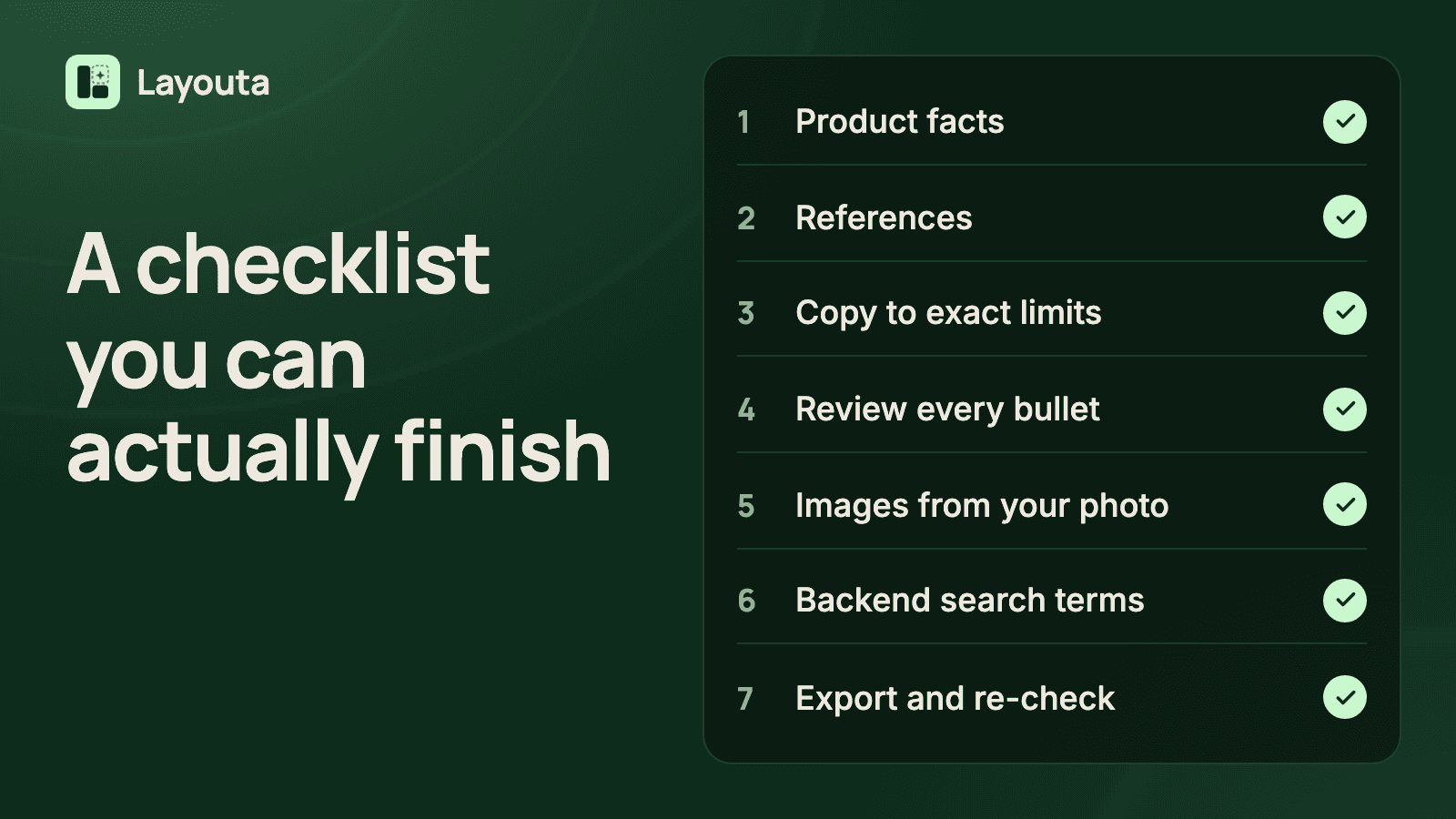
A Product Listing Optimization Checklist Sellers Actually Finish
A practical, in-order checklist for product listing optimization — facts, references, copy, images, and export — built around what you can actually confirm about your product.

What Actually Goes Into an Amazon Product Listing (And Where Sellers Lose Points)
A structural breakdown of every part of an Amazon product listing — title, bullets, backend search terms, main image, and gallery — and the specific way each one commonly loses a sale.

Amazon SEO Services vs. a Tool You Run Yourself: What Actually Moves a Listing
What Amazon SEO services actually do for a listing, what a self-serve tool can and can't replace, and how backend search terms and copy actually get you found.